Monday, 10 July 2017

Top 10 birds you should see in Australia(Part 1)

We have lived in Australia for almost five years. Over the various road trips I have been on, I have enjoyed seeing a lot of native Australian birds. Below is my personal top ten list of native birds I have seen on these road trips and around my home. If you consider travelling in Australia, be sure to look out for these birds!

Note on conversions: Since I have lived outside of the United States for so long, all of the distances and weights in this article are given in the metric system. If you live in the US, you can use this conversion to get an idea of these quantities:
1 centimeter(cm) ~ 0.4 inches(1in = 2.54cm)
1 meter(m) ~ 3.3 feet
1 kilometer(km) ~ 0.62 miles(1mi ~ 1.6km)
1 gram(g) ~ 0.035 ounces(1oz ~ 28g)
1 kilogram(kg) ~ 2.2 pounds


10: Australian Brushturkey

Alectura lathami
Female Australian brushturkey

The Australian brushturkey, frequently called the bush turkey or scrub turkey, is very common across the entire east coast, from Melbourne to Carins. They are commonly seen in backyards in this region and can become a pest in some areas, since they steal food(usually fruit) often.

Like the Mallee fowl and other Megapodes, male brush turkeys make nests composed of leaf litter, which they rake up using their feet from a large patch of ground. These nests are built under tree shelter and can be a mound up to 1m high and 4m wide. I have seen the building of these nests disturb human habitation when the nest was built in a backyard, the turkeys rake trails of leaf litter across a road or public pathway, or they rake away all of the mulch in a garden. Each male brush-turkey typically has several mates, which lay eggs in its mound. The turkeys check the temperatures using their beaks and rake layers on or off whether the nest is too hot or too cold. A brush-turkey nest can have up to 50 eggs in it. After the chicks hatch, they receive no further parental care.
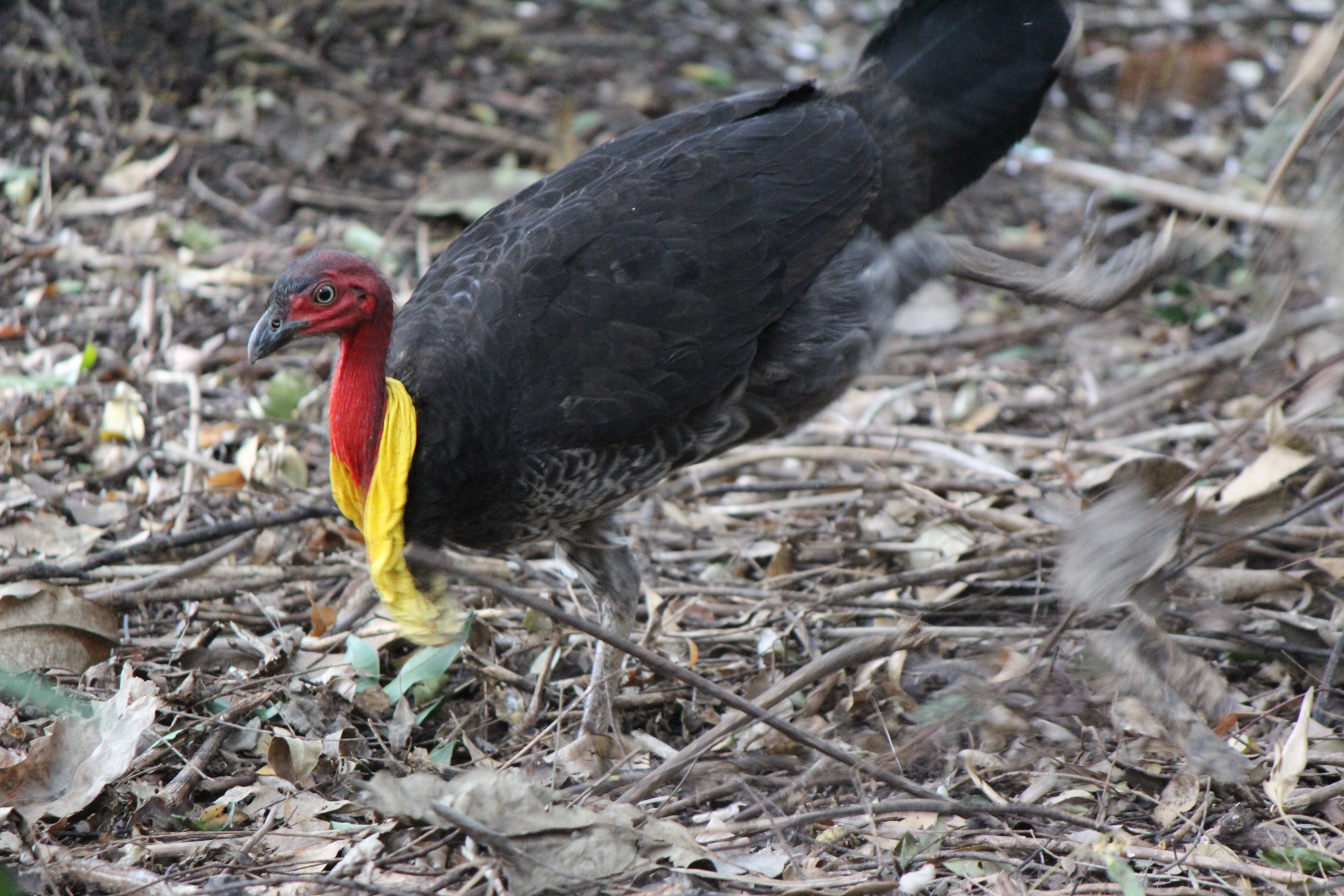
Male brushturkey

Description: Australian brushturkeys are not easily confused with any other Australian bird. They are about the size of their relatives, peafowl and junglefowl, and they have a laterally flattened tail. They are mostly black, but they have a red coloured head with no feathers, while females usually have a yellow band around their neck and males have a yellow wattle.

How to find: If you stay in the area for a few days, you would be lucky not to see one! Most of them live close to human habitation and they are common in backyards and on rooftops, but mostly in parks.

Diet: Brush-turkeys dig in the ground for insects, seeds and fruits. To get to insects they break open rotting logs with their feet.


9: Australian Pelican

Pelecanus conspicillatus
Australian pelican swimming

Australian pelicans are a common sight on lakes and rivers where there is not too much human disturbance. They are pretty large birds(medium-sized for pelicans) and have a wingspan of about 2.5m. They usually weigh 4.5-7.5 kilograms. Despite their size, pelicans can fly pretty well(Although they do look kind of awkward when they fly). They can be seen anywhere along the coast.

Lake Eyre is a large salt flat in South Australia which has a watershed spanning a large part of the outback. Once every few years, lake Eyre fills with water. During this time, many species of birds, including pelicans, fly there from all around Australia to gather at the edge and breed. During one of these periods, from 1989-1990, there was an estimated number of 200,000 pelicans, or 80% of Australia's total population. The fact that they can sense the filling of lake Eyre from the coast, in some places thousands of kilometers away, is still a mystery.

Description: Pelicans are mostly white, although the wings are mostly black. Males are larger than females. The Australian pelican holds a world record with the largest bill of any bird, which can be 40-50cm long, longer in males than in females. The pelicans also have a yellow rim around the eyes, making the eyes appear bigger.

How to find: Most pelicans eat fish from the sea or brackish water, so you are likely to see them around docks, harbours or jetties. They scavenge food from humans sometimes, so they often roost near human activity, usually in high places like on lamps and tall poles. They can also be seen flying overhead.

Diet: Pelicans mainly eat fish, which they catch while swimming with their long bills.


8: Laughing Kookaburra

Dacelo novaeguineae
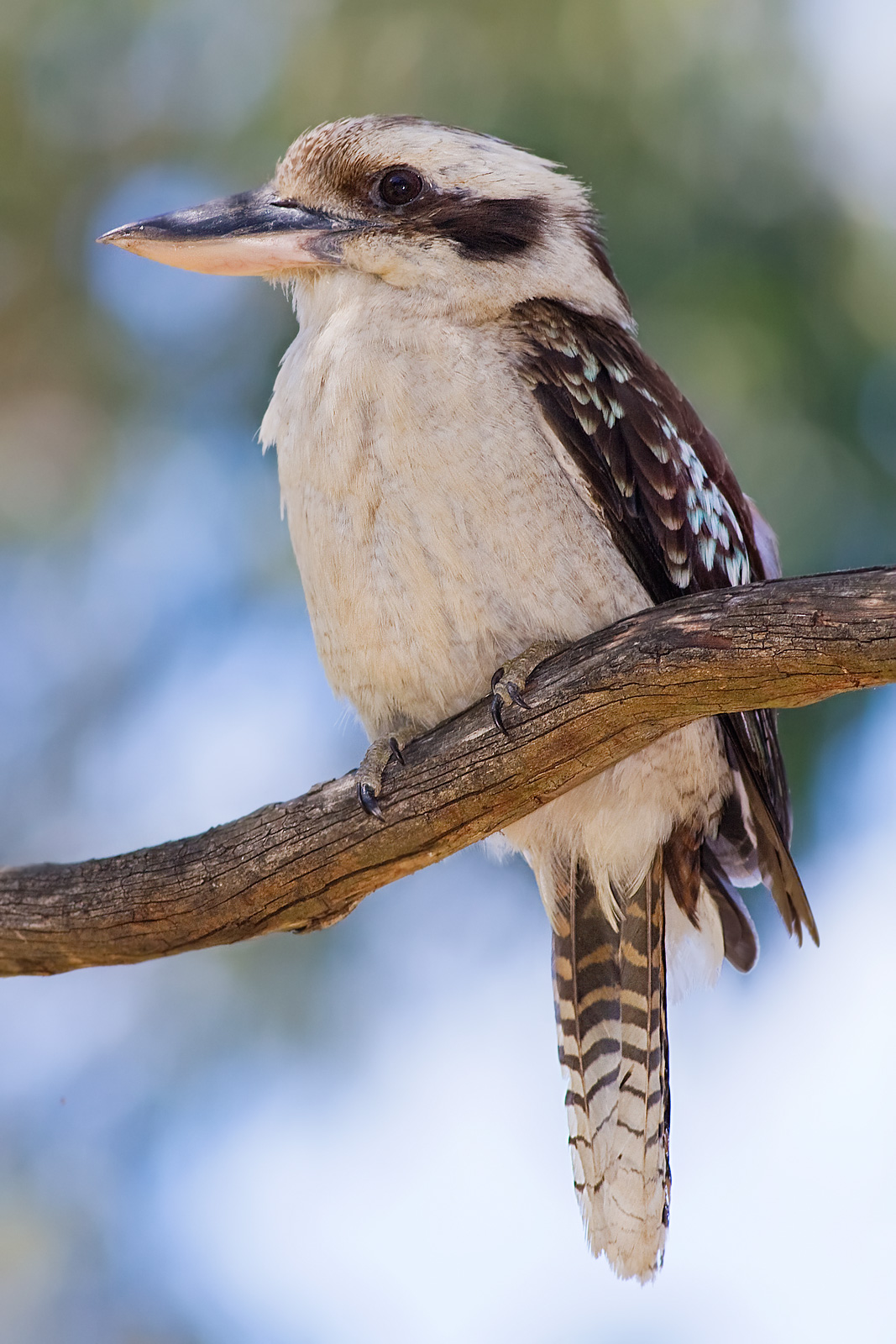
Laughing kookaburra

The Laughing Kookaburra is closely related to the Blue-winged kookaburra, which lives in northern Australia and New Guinea. Laughing kookaburras are known by the popular song, although many people might not know what they are. Kookaburras are in fact a member of the Kingfisher family, and they have heads and beaks suitable for catching fish and other small prey. Most of them, however, do not live near lakes or rivers. They are mostly found around Sydney, but some live in other parts of the East coast.

The most distinctive thing about laughing kookaburras is their call. They use it to warn other kookaburras of danger or as a territorial call to stop other families of kookaburras or other birds from intruding on that family's territory. It starts with one kookaburra, which initialises the call, then continues when others join in as a group. It sounds like laughing or chuckling.

Description: Laughing kookaburras are mostly white, with dark brown on the wings, and the tail is barred with black. They have a brown horizontal eye-stripe, and the upper beak is blue, while the lower part of the beak is white. They also have bright blue spots on their wings.

How to find: Kookaburras are almost always found in trees, on branches that are straight and horizontal, preferring eucalyptus trees. They can be seen in public parks around picnic benches, because they occasionally steal food from humans, but not very often. They can be very brave sometimes and come up to people to beg for food.

Diet: Insects, small lizards and snakes, also fish when present. When they are hunting, they sit very still on a branch, and when they see movement on the ground, they dive down and make their catch, which is interesting to observe.


7: Tawny Frogmouth

Podargus strigoides
Frogmouth perching on a balcony in Sydney

Because of their nocturnal habits, low call, silent flight, diet, and similar colouring, tawny frogmouths are very easily mistaken for owls, although they are more closely related to nightjars than to owls. Tawny frogmouths can be seen anywhere in Australia, even in Tasmania, except for dense rainforests and the outback, and they are very common along the East coast, around Sydney and Brisbane.

Tawny frogmouths sleep during the day, and they need to be safe from predators during this time, so their colours make them able to camouflage. They sleep on tree branches, and their feathers make them able to blend into their surroundings so well, that they are even hard to see in broad daylight. When they are sleeping, tawny frogmouths tilt their head upwards to help this disguise. Even while awake, they hardly move at all, so they might appear to be fake. They sometimes sleep in pairs.

Description: Tawny frogmouths have a mottled pattern that allows them to camouflage, with black, light brown, darker brown, and silver-grey. They have a very big head and a wide beak. During the night, they make a deep, continuous 'ooo-ooo' sound.

How to find: Sometimes, tawny frogmouths can be seen sleeping on a railing during the day. When they do this, you can come close up to them, but it is best to be very quiet, to avoid waking them up. Their call can be heard during the night.

Diet: Tawny frogmouths are carnivores, and they eat mainly worms and insects. They are considered one of the best Australian pest control birds, as they hunt a large variety of the animals usually classified as household pests. Unlike owls, they catch their prey with their beaks instead of their feet.

6: Emu

Dromaius novaehollandiae
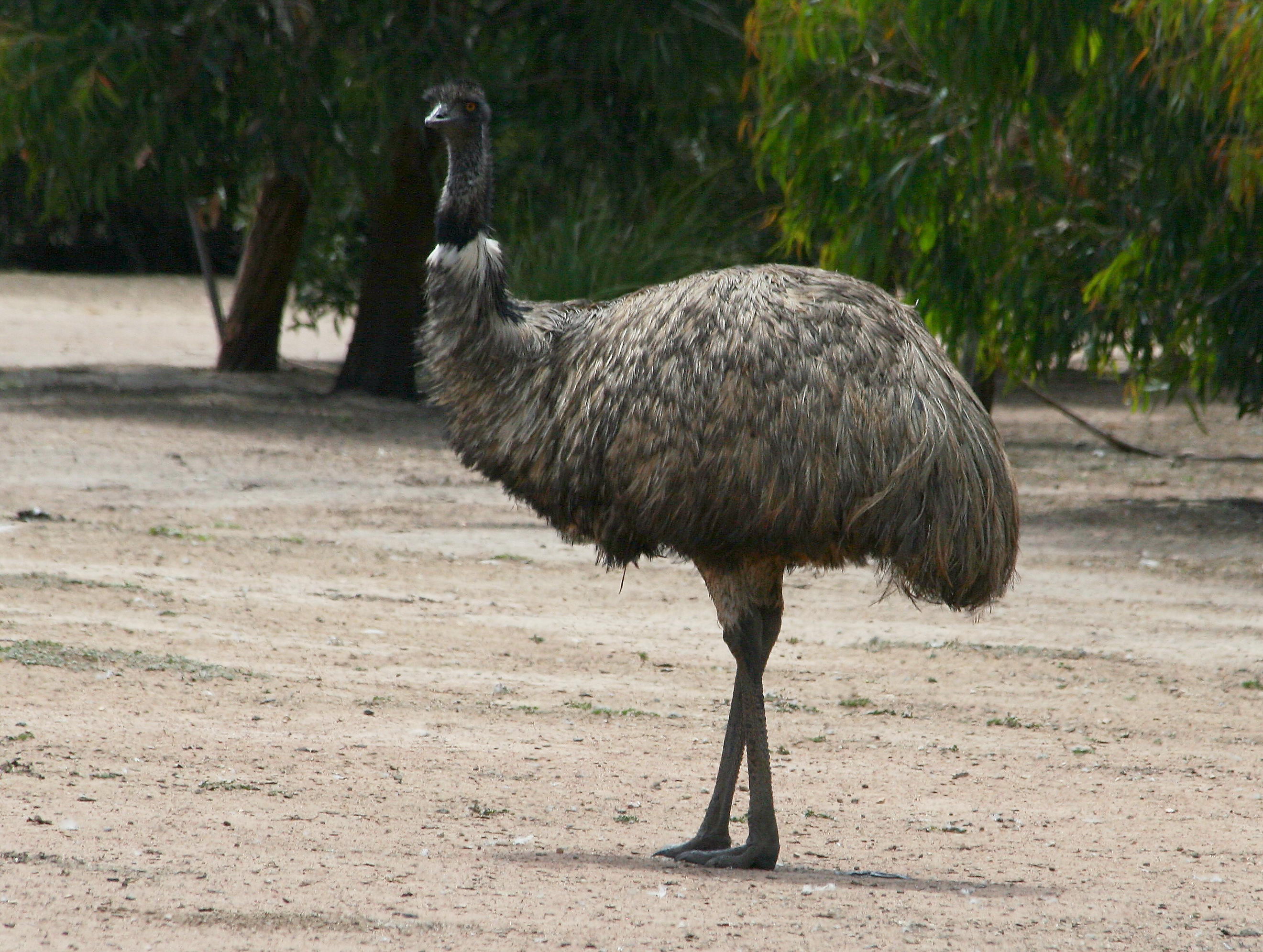
An emu in a zoo near Melbourne

The emu is a very large, flightless bird. It is the largest living bird by height apart from its relative, the ostrich, and they have a height that can reach up to 1.9 meters. I have seen emus run very fast, and they can run up to 50 kph(30mph). Emus live almost everywhere in the Australian outback, and also in a few other places, like the Flinders ranges, where they are very common.

The Emu is a major icon of Australia, appearing on the coat of arms and playing a large role in aboriginal mythology. Many aboriginal groups have a 'constellation' in the shape of an emu, made from the dark parts in the Milky Way. This 'constellation' stretches across the Southern Cross and Scorpius, and is only visible in a clear night sky.
Australian coat of arms, with the emu on the right

Like the brushturkey(above), the male emu does all of the work in caring for the eggs. The male also cares for the chicks. In the Flinders Ranges, I have seen a male emu with eleven chicks, which it was very protective of, rearing up towards the car while the chicks were crossing the road. The only work the female does is laying the eggs.

Description: Emus are very tall, in many cases taller than a person. They are covered with thin, shaggy brown feathers, except for the feet, head and neck. The head and neck have a pattern of black and bright blue and a thin layer of feathers. Emu chicks are brown with white stripes.

How to find: Emus can be seen anywhere in the outback, and sometimes groups walk straight through small towns. They are very easy to find on a drive through the Flinders Ranges or anywhere in the outback.

Diet: Emus are herbivores, and they eat from a large variety of plants, eating fruits, seeds, and small insects, and they swallow small stones to help them digest their food. Living in the outback, they can go several days without water if necessary.


This is the end of part 1. I will post part 2 sometime in the next three weeks, but not sooner than two, because I will be taking a trip to the Netherlands. In the meanwhile, I would like some suggestions of some birds that I can add to my list for part 2, especially birds common in Western Australia, where I have not travelled.

Friday, 31 March 2017

Superfluids

Quantum mechanics is very strange and hard to understand. Even today, most of it is merely theoretical, and it behaves much differently than the visible world.

Take quarks, for example. One of the smallest subunits of the things you can see around you are atoms. All atoms have a nucleus, which is composed of protons and neutrons. Protons and neutrons are made of quarks. There are six different types of quarks. They include Up and Down quarks, which protons and neutrons are made of, and also the Strange, Charm, Bottom and Top quarks. The largest type of quarks, Up and Down quarks, are about 10,000 times larger than the smallest type, the Top quark(This can be shown in the zoomable comparison here). The strange thing about this is, that the Top quark is almost 100,000 times as massive! This is an example of a phenomenon of quantum physics that shows that things at that scale greatly differ in behaviour from objects that we can sense. Another phenomenon is that neutrinos coming from the sun change into other types of neutrinos before reaching earth. Most of these phenomena are only theoretical, and cannot be seen or visibly detected, but some of them can.

One of the most remarkable of these phenomena are superfluids. When liquid helium gets lowered to a temperature below -271 degrees Celsius(2.177 degrees above absolute zero), it shows some very strange properties.

Superfluid helium has very little viscosity, so it has little friction with its surroundings. If you stir it, it can keep swirling for days. It is possible to detect its viscosity, but when a superfliud flows through very small holes or channels that normal liquid helium cannot go through, it has no measurable viscosity. This leads to the theory that superfluids are actually a mix of pure superfluid and normal liquid.
Demonstration of the fountain effect.

The theory that superfluids are all partly normal liquid can be tested by the fountain effect. In the fountain effect, a hole filled with a very fine powder is placed in superfliud helium. The superfliud part goes through the hole and into a bulb, but the liquid helium part cannot go through. If the bulb containing 'pure' superfluid is heated, it turns into an ordinary liquid. More superfluid flows into the bulb, in order to keep the balance of the fluids, which increases the pressure. If the bulb has an outlet at the top, the liquid would 'fountain' out, as shown in this video.

Another strange thing about superfliuds is that they have no thermal resistance. If superfluid helium gets heated slightly in one place, the heat would not spread out slowly, but it would travel outward in waves so fast that the heat is instantly distributed. These waves are known as 'second sound'. This also means that when superfliud helium boils, it does not bubble, but evaporates directly from the surface.
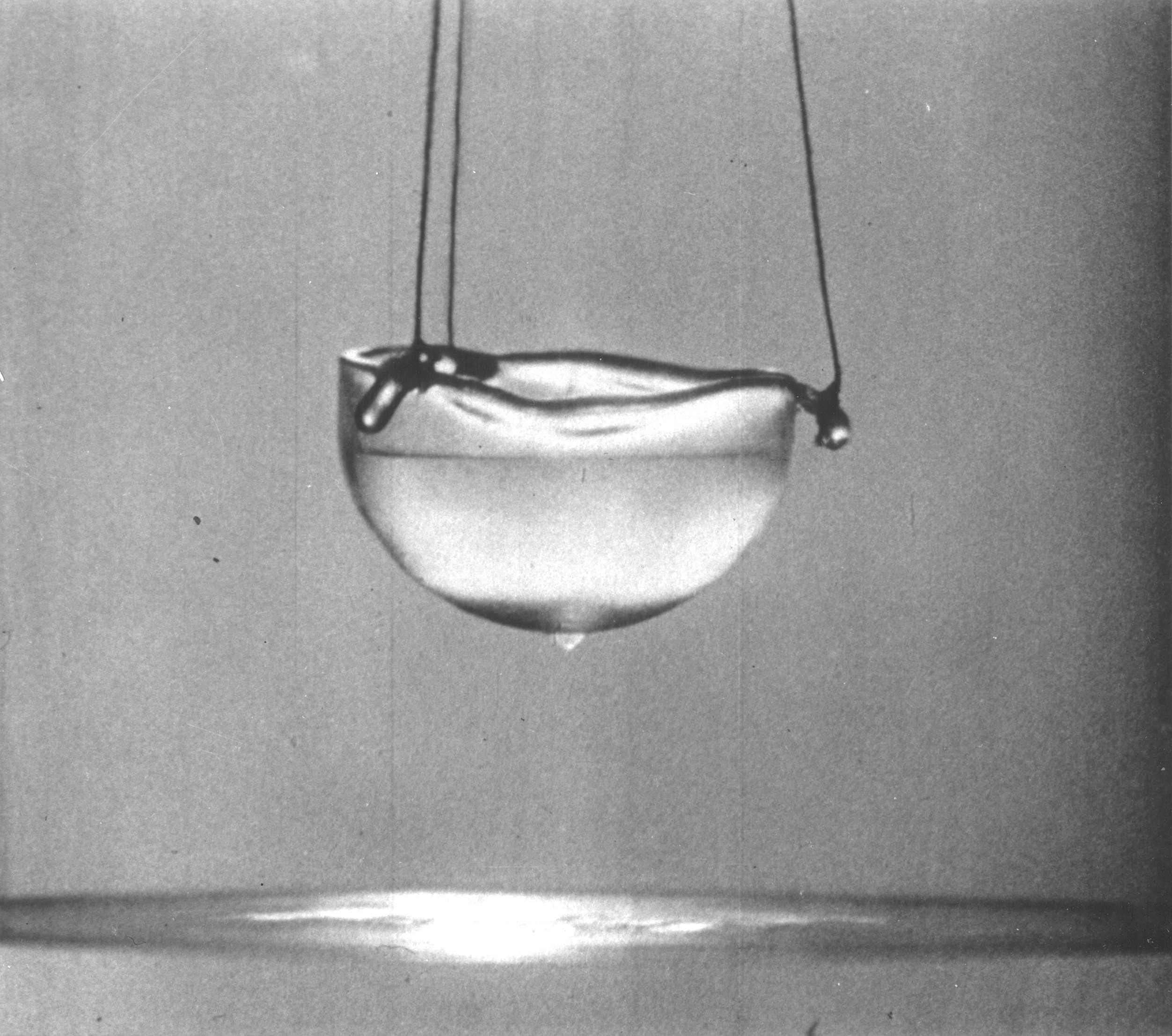
Superfluid helium escapes containers.

If the bottom of a thin tube is placed in water, the water will flow, seemingly against gravity, up the tube via capillary action. This is how plants get water from the roots to the leaves. All liquids do this, but this is limited by their viscosity. Since superfluids have no viscosity, they can creep through small tubes, and even over the walls of containers, and never stop until they become heated and evaporate. This makes superfluids very difficult to contain. If a container of superfluid helium is held above ground, It will seem that the fluid leaks through the bottom of the container, but interestingly, it actually travels up and over the side of the container and drips off at the bottom. It travels over the container as a film of fluid, only 30 nanometers thick, and at a speed of 20 centimeters per second, known as Rollin film. Waves are observed in Rollin film, and they move across these films. These waves are known as 'third sound'.

Some people argue that superfluids are a state of matter, like solids and liquids. It behaves like a liquid in some ways, but like a gas in other ways.

You can watch this video which demonstrates some of the properties of superfluids.


Resources:

Wikipedia

Sunday, 19 February 2017

Anne Frank's diary

Anne Frank was a young Jewish girl whose family went into hiding during the second world war. She was one of the most famous victims of the holocaust because of the fact that she kept a diary during her time in hiding and documented every detail of their time there.

Anne was born in June 1929. She lived in Germany until 1934, when Hitler took control of Germany and the Frank family was forced to flee to the Netherlands. They took residence in Amsterdam.

After the Netherlands surrendered to Germany in 1940, the Franks, being Jewish, started being restricted by many rules and regulations that the Germans had made. Among these were, that Jewish people could not use public transport, Jewish people had to wear a star of David, Jewish people had to go to certain stores and had to send their children to Jewish schools, and many, many more. These rules had started accumulating in Germany over a long period since years before the war, but as they kept getting added, the Jews got more and more restricted. Soon they weren't allowed to have bikes, and they had to walk everywhere.

In June 1942, Anne got a notebook for her thirteenth birthday. She decided to use it as a diary, and started writing in it. On the fifth of July, her family received a call-up from the Nazis and had to move their plan to go into hiding ten days forward. They took their possessions and moved to a section in the back of the factory where Anne's father had worked. They started staying there with another Jewish family.

Anne was the youngest of the people in hiding. She was with her mother and father, Edith and Otto Frank, and her older sister Margot. They were hiding with the Van Pels family, who Anne called the Van Daan family in her diary. The Van Pels family included Auguste and Hermann Van Pels, and their 16-year-old son Peter. In November, since both families had agreed that their hiding place could fit another resident, they were joined by Fritz Pfeffer, a German dentist who wanted to hide from the Nazis but unlike the Franks, who had become fluent at Dutch, Pfeffer spoke a mix of Dutch and German. He was referred to as Albert Dussel in Anne's diary.

In her diary, Anne called their place of hiding the "Achterhuis", translated into English as "secret annex". It was a three-storey area at the back of the factory. The people who worked there brought them food and told them what was happening in the outside world. They also designed and built a bookshelf to conceal the door to the Achterhuis. The bookshelf was on hinges, so that the helpers could easily get in and out.

The residents had to be extremely quiet during the day, to avoid being heard by the people in neighboring buildings. They had to tiptoe around the house, and whisper to each other. Being seen on the street was too risky, and they had to stay in the building for all of the two years they lived there. Everyone there knew, that at any minute they could get arrested by the Germans, and this caused a lot of stress and tension among them. Despite all this, Anne kept a lot of hope and optimism.

During March 1944, Anne Frank heard on the radio that manuscripts such as diaries written during the war would have a chance of being published after the war. Anne, with a view of becoming the author of a published novel, started writing a second edition of her diary, excluding some parts, rewriting others, adding new text, and giving all of the helpers and all of the residents of the Achterhuis pseudonyms.

In the October of 1944, Anne Frank and the other Jews in hiding were found and arrested by German troops. Anne and her sister Margot were taken to the Bergen-Belsen concentration camp, where they died of typhus in February 1945, only two months before the camp was liberated by English soldiers.

Right after the families' arrest, one of the helpers, Miep Gies, found the diary that Anne Frank had left behind. She hoped to return it to Anne after the war. She did not want to read it, because she knew that if she did, she would want to burn it, due to the fact that it contained the names of all of the people who were helping the Franks.

After the war, Anne's father Otto Frank, who, out of the eight Jews that had lived behind the factory, was the only one that survived the war, came back to the place where they had lived for two years. Once Anne's death was announced, Miep gave him the diary, along with the other notebooks and papers that the second edition was written on. Otto used both the original manuscript and the extra notes to construct a version of Anne's diary that got published in Dutch in 1947. The diary was titled "Het Achterhuis" and had five printings by 1950. Otto also assisted in rescuing the building from demolition and turning it into a museum. The museum is known as the "Anne Frankhuis" in the Netherlands and is still accessible today.

Today, Anne Frank's diary is well known and has been translated into 67 languages with over 30 million copies sold. Anne is seen as a symbol of the persecution of Jews during the second world war.

Friday, 30 December 2016

My entry for the Dear Friends letter 2016

2016 was a good year for me. One of the many highlights for me this year was Geocaching. Geocaching is an international sport which consists mainly of finding hidden boxes in the woods with a GPS(Co-ordinates are posted online). I found out about the game in April this year, and since then I have found 51 geocaches with my phone. I got to most of them on my bike and some of them on family trips and vacations, including trips to the Netherlands and Singapore.

Sailing season is around Summer(October-March in Australia), so this year had parts of two sailing seasons. The first, when I went to the Royal Queensland Yacht Squadron in Manly, QLD, started in late 2015. During that term I completed the Tackers course, which teaches basic knowledge of sailing for children. I needed the certificate from Tackers to get into Green Fleet(higher level teaching, including the rules of racing). I sailed in Green fleet through the beginning of 2016 and up until March. By then, the sailing season had ended, and I finished Green Fleet and was allowed to sail in a higher level group, Intermediate Fleet(also called Blue Squadron) during the next season. Unfortunately, sailing in Intermediate Fleet required owning a Laser at the sailing club, which are very expensive. Because of this, I had to start sailing at another club the next season.

Starting at October, I sailed at the Humpybong sailing club at Redcliffe. Since I had completed Tackers, I was able to get straight into Green Fleet. Because there are no higher-level courses at Humpybong, the next step was to become a Tackers assistant instructor. I enrolled in a two-day course back at Manly and got an AI certificate. The course I will be helping with will be in early January.

Meanwhile, I had been reading many books with Steve every evening. This year we finished The Grapes of Wrath by John Steinbeck, we read Much Ado About Nothing by Shakespeare, which we watched with my grandmother, and we read Catch-22 by Joseph Heller.

I have also been practicing clarinet regularly and have passed the grade 3 music examination for clarinet. I am now working on some pieces of music for two auditions which are both scheduled mid-January.

One of the biggest highlights for the year was the trip to the Netherlands. As it started, eight time zones of air travel made August literally the longest month of my life(and September the shortest). We switched to a connecting flight in Dubai on the way and saw some of the airport. A few days after we got to Leeuwarden, capital of Friesland, we took a ferry to Terschelling, our favourite island. It is a small island, only 30km long, and I had a lot of fun biking around the island and seeing the nature, the towns, the farmland, and the ruins of German WWII bunkers. After staying there for 3 weeks, we went south to the city of Nijmegen, stayed there for a few days and went around to an amusement park and the German border. Then we went back to Schiphol and flew to Singapore. We stayed there for 3 days and then returned to Australia. It was the best trip I had in 4 years.

Lost World

The Gold Coast is a weird place. Lots of beaches, lots of sunlight lots of high rises, no hills. It's kind of well known in Australia for being the Australian equivalent of Miami -- lots of high rises against the beach, inhabited by both rich and poor. People go there for vacations, or just to say they've been there. Like I said it's a weird place. On the Southern end of the Coast rises a series of low hills. These hills, which are low and fairly unpromising, rise quickly into a landscape which bears no resemblance to the strip malls and big houses below. Protected by the Lamington and Springbrook national parks, the landscape traces the border and is called the McPherson Range.

Many explorers have tried hard to map the area, but the McPherson Range is the size of Rhode Island and much, much more impenetrable. Who knows; there might be undiscovered plants and animals in the area. The first road to lead into the area led to O'Reily's, a rainforest guesthouse that still stands today. Nowadays, many tracks and roads cross the range and we went on one of them to reach Green Mountains.

Green Mountains is the part of Lamington National Park that surrounds O'Reilly's. It contains some of the most mountainous, inaccessible rainforest in the entire park. The road to O'Reilly's, which has not changed route or width since it was built, is a one-lane road with many blind curves which looks like spaghetti on a road map. On the way there, the road even leads through a long, squiggly one-way cutout to get past a series of cliffs! We spent a very brief time in the Mountains -- two days. But during that time we saw a lot of the park, and really got a feel for what the mountains were like.

The morning after arriving, I and my dad and my brother set off for an extended hike: the Albert River Circuit, a seven hour hike that did most of the walking far away from the Green Mountains campground. We got up early to do the hike. There was no trail that led from the campground, so we walked along the road and past a parking lot to get to O'Reilly's. The O'Reilly's lodge has changed a lot since it was built, and it is now the centre of a large clump of hotel buildings, a cafe' and a souvenir shop. The O'Reillys still own it, though.

Across the road was the main trackhead, at a sign declaring that we had just arrived at the Border Track, a long trail connecting Green Mountains to a distant trailhead, Binna Burra. The Border Track is very well maintained for being the starting point of most day hikes in Green Mountains. We walked easily along the hard clay path before seeing a land mullet. Land mullets are a very large species of skink. This one was so big, I could have mistaken it for a baby crocodile if it had spikes on its back.

We continued to walk past intersection after intersection, always going straight ahead. The trees are gigantic in Lamington. Giant figs coated with vines and epiphytes loomed out of the green haze of the tree ferns. Vines were everywhere, and wherever there weren't vines there were cliffs. No small wonder explorers took so long to get this far. As the downhill slope on our left got steeper, I could sense a gigantic chasm to our left side, much deeper than it was wide. Both up and down, the slope went on and on without end. It was like we had shrunk to the size of insects, or like a small valley had grown to the scale of the Grand Canyon. Everything was much, much bigger than it should have been.

After an hour and a half of walking, we passed a gigantic Antarctic Beech -- so named for the place it was first identified, as a fossil -- and reached the beginning of the Albert River Circuit. We left the main trail on the right and followed an overgrown track, dodging fallen trees as the track narrowed. The Albert River flows on the next valley over from the Border Track, so I had expected to top out onto the ridge top between the two valleys. We never did. Instead, we contoured across the slope as it got steeper and and the path got surrounded by cliffs. For the whole time the track was doing this, I never suspected that we were slowly turning to the right, slowly winding around a mountain peak. Until the track switchbacked and it was obvious we were in a different valley than we started in.

The walking book we had (which was fairly outdated and may not have taken into account a track closure) told us we would reach the first waterfall of the track, Jimboomba Falls, about half an hour after turning off the Border Track. It was full hour and we had not even seen a creek yet. Then suddenly, we turned a corner and crossed a dry creek bed. Stupidly thinking this was Jimboomba Falls, we kept walking and then saw something totally weird. It was a lobster. Except it was crawling along dry ground far from a flowing creek. And it was blue and white. I don't know why -- I mean, it was just a lobster -- but it weirded me out. I learned later that this was a Lamington Spiny Crayfish, a freshwater yabby endemic to the Mcpherson Range between Tamborine and the Main Range.

Excited about the find of the crayfish, we walked easily to what was actually Jimboomba Falls to have a snack. The falls were just a small cascade, but they were interesting to see partly because thick moss growing on the sides made them look otherworldly. After checking for leeches we continued on a steep zigzag downward, sometimes clinging onto cliffs to avoid slipping and falling. Often we would have glimpses of the creek, which was always pouring over a high waterfall. At the end of the zigzag, we crossed the creek with glimpses of Lightning Falls -- a very high, free falling waterfall.

Earlier we had not been following the Albert River, but an offshoot called Lightning Creek. Just after Lightning Falls, we descended to the river itself. It was big, about five times as big as Lightning Creek. The first waterfall we discovered on the river was Mirror Falls. Mirror Falls was the most beautiful, mainly because of the mossy walls on either side of it. We passed four other, not very impressive falls in quick succession, before arriving at Echo Point Lookout which altered my view of the place completely.

Descending down to the creek was steep, but climbing back up was along more or less flat ground. Then we headed along a sidetrack to the lookout. Before I even arrived I could sense a void ahead of us, like we were standing at the edge of the Earth. In another minute we practically were. The Escarpment, which traces the New South Wales-QLD border, is a massive crescent shaped cliff that drops steeply and almost vertically about a kilometre into the plains below. We were standing on its edge, from which we could see the hulking ramparts of Mount Warning, the Border and Nightcap Ranges and even Byron Bay and the entire Gold Coast. It was the best view I have ever seen in SEQ, hands down.

We zombie walked for two hours back out along the Border Track, collapsing at what I hoped was a cafe'. It was the start of a treetop walk. Normally I don't like treetop walks -- I mean, they seem to be everywhere and I'm sick of them -- but this walk was pleasantly rickety and seemed like it would fall apart at any moment. I really liked it. We spent some time there, then walked back to the tents and collapsed.

If you are interested in walking the Albert River Circuit, or just want to know more, someone made an interesting video about it. A link is provided here.

The walks of the following day were done with another family who were friends of us. Since we had little time and energy left, we chose short walks around the area. The first one, to Python Rock, gave us a spectacular view over the mountains and really revealed how deep the gorges went. I would say they were about as big as Grose Gorge in the Blue Mountains, possibly bigger. Then we went on another walk, to the top of Morans Falls. But as we were arriving at the top of the waterfall, the sky broke apart and a torrential downpour began. Using any convenient track to get us back to safety, we ran up a muddy track labelled "O'Reilly's".

Suddenly, we emerged on an old gravel road. Not knowing where to go we just went right and found an old wooden shack. We raced to get under the eaves. Suddenly, Dad called to tell us the door was unlocked and we scrambled in. An information board revealed it to be an old slaughterhouse. My dad, I and my little brother were here, but no one else was, so we just sat inside and waited.

After twenty minutes the rain stopped. Noting that nobody had arrived yet, we just got out and walked along the track ourselves. Leaving the road to follow a promising looking track, we walked through a picturesque rainforest on a windy path that went through several large gum trees. Finally, we emerged at O'Reilly's where we met the others, sitting at a cafe'. They told us they had taken a different track, and had been waiting for us for half an hour.

Lamington is not the most amazing place in the world, or even Australia. But it is a great place and a must visit for anyone living in or visiting South East Queensland.

Thursday, 15 December 2016

Girraween

In this article I am going to relate to my experiences in the Girraween area -- both on the most recent trip and on one I did, a year back, with Scouts.

The Girraween is by any measure an amazing place. While its largest granite outcrop -- Bald Rock -- is a fraction of the size of Uluru, the Girraween area gives you a sense of beauty that Uluru and the nearby Kata Tjuta lacks. Furthermore it is much closer to Australia's cities, being a mere three hours drive from Brisbane in Queensland's Granite Belt.

What does the place look like? The Girraween is located on top of a high plateau. A visitor to the valley below would never suspect it was there, if the signs were taken away. The top of the plateau is a large, undulating landscape, unremarkable except in one way: the rocks. They puncture through vast ribbons of eucalypt forest like needles, standing high above everything else but each other.

My first summit of such an outcrop was the climbing of South Bald Rock, a dome of granite that looks vaguely like a bald man's head. It happened on a Scout hike a year back. South Bald Rock is no moderate peak, approaching a height of 150 metres relative to surrounding plains. From the top we could see all the other peaks from a 360 degree view. To the immediate West lay the West and Centre bald rocks, then the rocky rise of Mount Norman that all but obscured Turtle and Castle Rocks, the Sphinx, and the Pyramids. To the East the view was more breathtaking: we could see Bald Rock, but behind it was a continuous ribbon of undisturbed forest that culminated in the gray spire of Mount Barney -- which was 90 kilometres away and should have been out of sight. Due to the curvature of the Earth, Mount Barney looked lower than us.

After that initial trip to the Girraween I vowed to return, and I finally did in October of this year. Not with Scouts this time, but in a family trip with friends. In Scouts, we completed the Eastern Peaks Circut: a lengthy hike involving climbs on the eastern (New South Wales border) side of Girraween National park. This time, we would visit the more built-up, western side of Plateau. Here was a visitor's centre and even a campground.

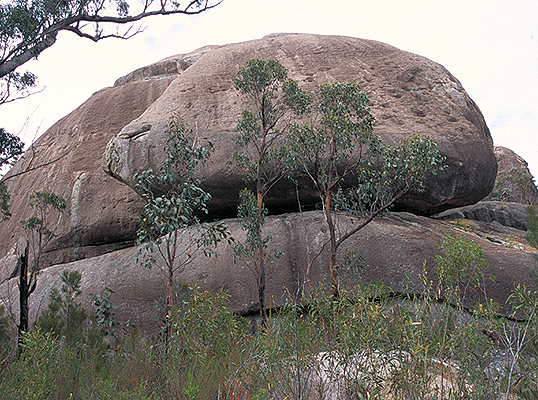
We were fairly ambitious on the first day, making a visit to the First Pyramid. The name of the Pyramid was inspired by its shape: a three or four cornered dome, tapering slightly at the top. To get to the summit we ascended a granite surface sloped at fifty degrees and smooth as glass. When we got to the top of this slope, we turned the corner and found the trail following a natural catwalk. Although the surface of rock was only tilted at thirty degrees or so, it tilted sharply toward a void I did not want to end up slipping into. My hands became shaky as I began the traverse, and I collapsed when I got to the other side.

The base is smaller than it seems.
We continued to the summit. The true summit was inaccessible as it was on top of a boulder, so we continued to a natural rock platform, from which we could see the climb route. Rather than sweeping 360 views we were promised by faraway views of the mountain, the view was dull and obscured by boulders. Still a good view, though. Then we scrambled to a viewpoint on the other side of the summit, which looked down upon another mountain: the Second Pyramid. It was weird, like a gigantic pudding dropped in the middle of the forest, and was completely devoid of trees or even subsidiary boulders. On the way back, we passed a boulder three times the size of a house yet balanced on a base the size of a dinner plate.

It was getting dark so we returned to the campsite.

The second day was much better. After some decision, we decided to walk to Turtle Rock.

Turtle Rock is a low dome of granite we saw from the Pyramid. It looks just like a sleeping turtle. Next to it is the Sphinx, a needle-like finger of rock poking out of a boulder field. The walk was supposed to take four hours, but we took five because we were exploring so much.

The walk began by climbing up through open eucalypt forest and scattered boulders. At long last, we got to the top of a ridge and followed it to the Sphinx. The Sphinx itself was not very impressive, but we spent an hour exploring the massive boulder field on all sides of it. A short walk brought us to the base of Turtle Rock. To get to the top, we scrambled up through a narrow gully. Then, just above a ledge with good views of The Sphinx, we were blocked from going further by a 5m cliff.
The turtle

The Sphinx and Turtle Rock from Castle Rock
I thought it was impossible to go further, but after some searching I found a slot crammed with boulders. If I scrambled along the boulders and chimney climbed through the slot, I could just make it. I did so. The going was hard though, and I almost got stuck twice. But I got to the top of Turtle Rock and was rewarded by 360 degree views.

On the return trip we climbed Castle Rock. It was much less exposed than The Pyramid and had much better views. After having climbed the mountain, we called it a day and retreated back into our tents.

Note: None of these pictures are ours.
Our final objective was Underground Creek. A short walk from the car park, Underground Creek was a creek that carved an overhang, which promptly buried the creek when it collapsed. Brave souls still venture into the cave below the overhang, to find the creek and more.

After thoroughly exploring Underground Creek, we set off for an offtrack adventure to find the fabled Aztec Temple (it's actually a jumble of boulders). We tried, and got as far as the ridge it sits on before turning back due to casualties.

The failed Aztec Temple expedition reminded us of how much we had not seen in the park. We will need to go back here sometime. As we drove home through the Main Range, I was reminded of how much there is to see in the world, and how we can only hope to see a fraction of it in our lifetimes.

The fabled Aztec Temple.

Saturday, 27 August 2016

Neutron

There is a recipe in the back of Edward Lear's Book of Nonsense which begins like this:

"Procure some strips of beef,  and having cut them into the smallest possible slices, proceed to cut them still smaller, eight or perhaps nine times."

The recipe raises some interesting questions such as: What would these tiny pieces of beef look like? Is it even possible to slice anything past the molecular level? There is another question I am more interested in. If you slice things into small pieces, they take up less space. Could you eventually make things disappear entirely, just by slicing them?

As a matter of fact, it is fairly easy to break apart molecules; your body is doing it now. Atoms are more tricky, but scientists have split the atom more than seventy years ago. You rely on atoms fusing together in the Sun, after all. To answer our first question, the beef wouldn't look like beef past the molecular level. In fact, if you managed to split apart every single molecule in a slice of beef at once, it would trigger an explosion as the oxygen fuses to form the kind of air you breathe. (if you did the same thing to atoms, you would make a large nuclear explosion.)

Of course, it takes some pretty tremendous forces to split atoms. The only place where it is done on a big scale is in the core of a large star, when it dies. If a star is much bigger than our sun, it struggles constantly to stop collapsing in on itself.  The star relies on fusing atoms to survive. The moment a star runs out of fuel, its inner layers collapse. The outer layers of the star crash into the inner layers, and rebound into space in what is known as a supernova. What is left is the core. In a Sun-sized star, the core left is a white dwarf, which glows for a while before winking out. However, in a large supernova, the atoms are so strained by gravity they split apart and form an extremely dense and often quickly spinning object known as a neutron star.

Neutron stars are really strange things. They can be the size of cities but the mass of the Sun. They are mostly made of neutrons. Many have a fragile 'crust', which can fracture and create terrifying power surges. Some orbit a star, which they suck power from. Sometimes neutron stars merge and create massive bursts of light. Some neutron stars, known as pulsars, spin several times a second and emit energy from their magnetic poles.

Most weird aspects of neutron stars come from their incredibly small size and their amazingly large amount of mass. There is a type of object which has even more mass and a smaller size than a neutron star: a black hole. Black holes are made by splitting the components of atoms apart into individual quarks. Black holes are really weird. They are objects with a gravitational field so extreme, they can bend light. You cannot even see a black hole; you just see, well, a black hole. Around a black hole, time slows down and everything is redshifted. We barely know anything about black holes at all. All we know for sure is that they are unimaginably small and dense.

I wish there was a way to split quarks - the components of neutrons and protons - apart, but there isn't, as far as we know. And finally we arrive to the answer of our third question: It is not possible to cut a slice of beef into nothing, but you can make a black hole.